From a Scripted Bots to Paraphrase Aware Chatbots
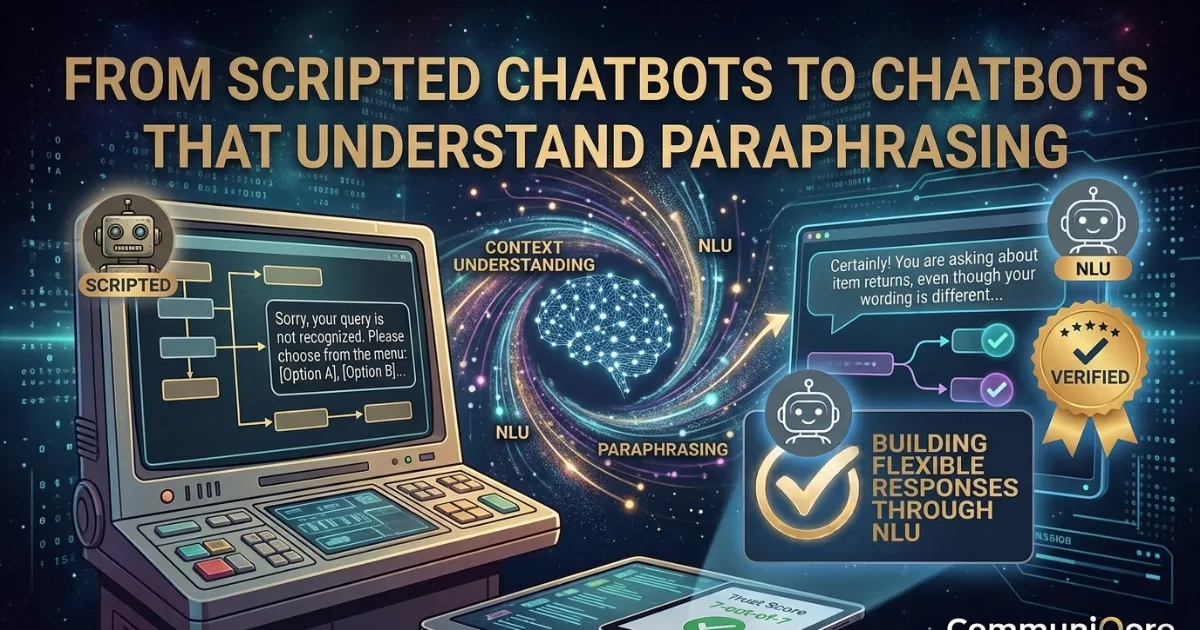
If you have ever been frustrated by a chatbot that replies with a numbered menu and seems deaf to what you actually asked, you have met a scripted bot. The approach is still widely used, and its limits are not a matter of being unintelligent. They follow directly from how it works.
Scripted bots match words, they do not grasp intent
A scripted bot runs on human-written rules: if the message contains this keyword, reply with that answer. As long as customers use anticipated wording, the result is fast and highly predictable. For narrow flows such as checking an order status, this is often enough.
Trouble begins the moment customers write in their own words. One intent can be phrased a dozen ways, and every unlisted phrasing misses. Patching by adding more keywords never finishes, because human language cannot be exhaustively enumerated.
The meaning-based approach
Modern chatbots take a different route. Instead of matching words, they compare meaning: both the question and the document chunks are turned into numeric representations, and the closest matches in meaning are retrieved.
The effect is immediate. Questions nobody anticipated can still find their answer, because what is being matched is the intent rather than the spelling. You also stop maintaining a keyword list that only ever grows.
But paraphrases can still trip it up
Here is the part that rarely gets told. Understanding meaning makes a bot far more robust to variation, but it does not make it immune.
A real example: two sentences with identical intent, can I use messenger and can the bot be connected to Facebook Messenger, can end differently. One is answered correctly while the other is told the feature is unavailable, even though the answer sits in the same document. The first is short, informal, and thin on distinctive terms, so retrieval loses its grip.
Language model failures are rarely total. Far more often they take the shape of working for one phrasing and failing for another with the same meaning.
So testing has to change too
Testing a scripted bot is relatively easy: walk every branch of its rules. A meaning-based bot cannot be tested that way, because there is no list of branches to walk. Two habits separate serious evaluation from casual trying:
- Each intent is tested through several paraphrases at once, including the short, informal versions customers actually type.
- The same question is repeated several times, because some cases are unstable and pass on one run while failing on the next. Such cases never surface from a single manual attempt, yet they surface constantly in front of customers.
The takeaway
Moving from scripts to meaning removes an entire class of old problems: the bot is no longer blind to phrasings nobody registered. What replaces it is a subtler class of problem that demands a different way of measuring.
The best source of test questions is not your team imagination but transcripts of real conversations. That is where you find the sentences you would never have thought to write yourself.
Business Info Administrator 24 Aug 2026 03:54pm